



What Causes Intimate Fungal Growth? (And How to Eliminate It Fast)
What Causes Intimate Fungal Growth? (And How to Eliminate It Fast)
Is light therapy the future of intimate wellness?
This non-invasive treatment utilizes targeted wavelengths of light to stimulate cellular repair, boost collagen production, and improve localized blood circulation in intimate tissues. Clinical evidence supports the use of light therapy for improving tissue elasticity and relieving dryness. While it works best for individuals experiencing mild to moderate laxity or age-related discomfort, it cannot replace surgical reconstruction for severe anatomical changes. This treatment offers a discreet, non-surgical option for busy Singapore professionals seeking to address intimate wellness concerns without downtime.

Introduction
The office farewell dinner is next Friday, and you have spent the week quietly dreading it — not the food, but the persistent itch and redness that no pharmacy cream has fully managed. It started weeks ago, easy to dismiss, but it has not gone away. For many people in Singapore, intimate fungal concerns sit in this uncomfortable middle ground: too common to be unusual, too personal to discuss openly.
Intimate fungal concerns affect a significant proportion of the adult population, with factors ranging from antibiotic use to tight clothing all contributing to the imbalance that allows fungi to thrive.
In this guide, Wellaholic’s expert team walks through what actually causes intimate fungal growth, why Singapore’s climate makes it harder to manage, and what modern light-based hygiene care looks like as a complement to conventional treatment.

Why Intimate Fungal Infections Keep Coming Back
The groin and intimate areas create near-ideal conditions for fungal proliferation: warmth, friction, and limited airflow. Candida albicans is the most frequently implicated organism in vaginal yeast infections, while Trichophyton species are the primary driver of jock itch in men. Both organisms are opportunistic — they exist in small numbers on healthy skin but multiply when the local environment shifts in their favour.
Common triggers include antibiotic courses (which suppress competing bacteria), hormonal fluctuations, elevated blood glucose, and synthetic or tight-fitting clothing that retains moisture against the skin. What makes recurrence so frustrating is that topical antifungals address the active episode but do not resolve the underlying conditions — humidity, microbiome disruption, or skin barrier compromise — that allowed the first episode to develop.
Many Singapore customers find that the same set of circumstances that caused the first flare-up are simply waiting to cause the next one.

How Fungi Exploit the Skin’s Defences at the Cellular Level
Fungi establish themselves by penetrating the outermost layers of the stratum corneum and secreting enzymes that break down keratin. This degradation triggers an inflammatory response — the redness, swelling, and itch that characterise both jock itch and vulvovaginal candidiasis. Blue light at 415nm has been studied for its ability to generate reactive oxygen species within microbial cells, disrupting cellular membranes and inhibiting replication without the systemic effects associated with oral antifungals.
Red light, operating at a longer wavelength, works in a complementary direction — supporting tissue-level recovery by reducing inflammation at the treatment site rather than targeting the pathogen directly. Together, this dual-wavelength approach addresses both the active hygiene concern and the irritated tissue responding to it.
This is why light therapy is increasingly explored as a non-chemical adjunct in intimate hygiene care, particularly for those who prefer to avoid prolonged topical drug use.

Why Singapore’s Humidity Turns a Manageable Issue Into a Persistent One
Unlike seasonal fungal flare-ups seen in temperate countries, Singapore’s climate — year-round relative humidity and ambient temperatures that rarely ease — means the skin in intimate areas never fully decompresses between exposures. Sweat accumulates throughout the day; office air-conditioning causes rapid evaporation that can compromise the skin barrier; commuting in crowded MRT carriages raises temperature again. This cycle of moisture, dryness, and friction repeats daily without seasonal relief.
Wellaholic’s expert team at the Tanjong Pagar outlet — CBD-based and lunch-hour accessible — commonly observes that customers who work long office hours in air-conditioned environments followed by humid commutes report the most persistent recurrence patterns. The environmental trigger is never removed, only temporarily managed.
Addressing intimate fungal concerns in Singapore therefore benefits from a strategy that accounts for the climate as a structural factor, not an occasional one.

How WellaShield™ Light Therapy Works for Intimate Hygiene Care
For those dealing with recurring intimate fungal concerns — jock itch, fungal imbalances, or persistent discomfort that over-the-counter creams keep at bay without fully resolving — light-based hygiene care offers a different mechanism of action to conventional treatment.
WellaShield™ is Wellaholic’s dual-action light therapy designed for intimate area hygiene. Blue light at 415nm targets bacteria and fungi at the cellular level to inhibit growth, while red light reduces inflammation and supports the tissue’s natural recovery process — both delivered in a single 30-minute session. The treatment is non-invasive, requires no downtime, and is conducted in a private room by Wellaholic’s expert team. It is suitable for both men and women dealing with recurring intimate hygiene concerns.
WellaShield™ Pricing (GST-Inclusive)
| Sessions | Price |
| 1 Session | $149 |
| 3 Sessions | $142 |
| 6 Sessions | $134 |
| 12 Sessions | $119 |
To find out whether WellaShield™ is the right fit for your concern, book a consultation with Wellaholic’s expert team at any of the four outlets.

Conclusion
Intimate fungal growth is not simply a hygiene failure — it is a biological response to conditions the skin was not designed to manage indefinitely without support, and Singapore’s climate compounds every contributing factor. Understanding the triggers — from antibiotic disruption to the daily humidity cycle — is the first step toward managing the pattern of recurrence more effectively.
For those who have found topical solutions insufficient on their own, Wellaholic’s expert team is available across all four outlets. The Somerset outlet sits three minutes from Somerset MRT Exit B in the Orchard area. Tanjong Pagar on Telok Ayer Street is CBD-located and structured around lunch-hour appointments. The Kovan outlet serves the heartland and is open until 10pm for those who cannot fit treatment into a workday. Upper Changi is located inside the MRT station itself, making it genuinely convenient to visit without breaking stride.
Key Takeaways
- Intimate fungal growth is a conditional overgrowth, not random exposure — it occurs when the local skin environment shifts in favour of Candida or dermatophyte proliferation through factors including moisture, hormonal changes, and microbiome disruption.
- Antibiotic use is one of the most consistent triggers — courses that deplete protective bacterial flora create a competitive vacuum that fungal organisms readily occupy, particularly in warm, occluded areas.
- Blue light at 415nm disrupts fungal cellular membranes by generating reactive oxygen species, providing a non-chemical mechanism that operates independently of antifungal drug pathways.
- Singapore’s humidity is a structural, year-round trigger — unlike temperate climates where seasonal dryness provides natural relief, Singapore’s intimate skin environment rarely fully decompresses, making recurrence more likely without active hygiene management.
- Dual-wavelength therapy addresses both the active concern and the tissue response simultaneously — the blue light targets microbial activity while red light supports inflammation reduction, rather than addressing these two dimensions in separate steps.
Frequently Asked Questions (FAQ)
Q1: Is WellaShield™ a replacement for antifungal medication?
WellaShield™ is a professional light therapy service for intimate hygiene care, not a pharmaceutical intervention, and should not be positioned as a direct substitute for medically prescribed antifungal treatments. For active, diagnosed fungal infections, a healthcare professional’s guidance remains the appropriate first step. Many Singapore customers use WellaShield™ as a complementary approach — addressing the hygiene environment and tissue inflammation alongside or following conventional treatment, rather than in place of it.
🔵 Blue light targets microbial cells at the cellular level, not systemically
🔵 Red light works to reduce post-concern tissue inflammation
🔵 Non-chemical — no topical drug residue or potential skin sensitisation
🔵 Suitable as a complementary step after completing a prescribed antifungal course
🔵 Wellaholic’s expert team can discuss session timing relative to prior treatment history
🔵 Sessions are conducted in a private room with full discretion throughout
Q2: How many WellaShield™ sessions are typically needed for recurring jock itch?
There is no fixed protocol because recurrence frequency, contributing factors, and individual skin responses vary considerably. Wellaholic’s expert team typically discusses a customer’s pattern of recurrence — how often flare-ups occur, what triggers them, and whether conventional treatments have been used — before recommending a session cadence. The 6-session and 12-session pricing tiers exist to support customers who want a sustained approach to intimate hygiene maintenance rather than single-episode management.
🔵 Individual response varies — no fixed number of sessions applies universally
🔵 Recurrence pattern is the most useful factor in planning session frequency
🔵 Short-term management vs. longer hygiene maintenance are two distinct goals
🔵 Expert team consultation before the first session helps set realistic expectations
🔵 Session intervals can be adjusted based on observed skin response
🔵 The 12-session tier provides the lowest per-session rate for ongoing care
Q3: Is WellaShield™ suitable for both men and women?
Yes. WellaShield™ is designed for both men and women experiencing intimate hygiene concerns, including jock itch — more common in men due to heat retention in the groin area — and fungal imbalances more commonly associated with the vulvovaginal region. The blue-and-red light mechanism operates on skin tissue regardless of anatomical specifics, and Wellaholic’s expert team adapts the session approach accordingly. All sessions are conducted in a private room to ensure comfort for every customer.
🔵 Suitable for male and female anatomy — treatment is not gender-specific
🔵 Jock itch (groin dermatophyte infection) is a common male presentation addressed by blue light
🔵 Fungal imbalances in the vulvovaginal region are a common female presentation
🔵 Private room sessions ensure discretion for all customers
🔵 Expert team adapts positioning and approach for anatomical differences
🔵 No prior light therapy experience is required before the first session
Q4: What should I do before and after a WellaShield™ session?
Wellaholic’s expert team generally advises avoiding the application of medicated creams, heavily fragranced products, or irritant topicals in the treatment area immediately before or after a session, as these may affect the skin’s response to light exposure. Breathable cotton underwear after the session and avoiding prolonged wet clothing or excessive sweating for a few hours are commonly recommended practical habits. Since WellaShield™ requires no downtime, most customers return to normal activities — including work — immediately after.
🔵 Avoid applying antifungal creams directly before the session
🔵 Fragrance-free intimate wash is preferred in the 24 hours surrounding treatment
🔵 Wear breathable cotton underwear post-session to reduce moisture retention
🔵 Avoid prolonged wet clothing (swimwear, workout gear) directly after treatment
🔵 No downtime required — normal daily activity can resume immediately
🔵 Inform the expert team of any active skin conditions or open irritation before starting
Q5: Does intimate grooming affect fungal risk, and does it interact with WellaShield™?
Hair removal in intimate areas reduces the surface area available for sweat and moisture retention, which can lower the micro-environment conditions that fungi prefer. However, waxing and shaving also temporarily affect the skin barrier at the follicle level, which may create a brief window of increased sensitivity if the area is not kept clean and dry. Wellaholic’s expert team advises spacing WellaShield™ sessions away from recent intimate waxing to avoid treating freshly sensitised skin.
🔵 Hair removal reduces moisture-trapping surface area in the groin region
🔵 Post-wax skin barrier disruption is a temporary window of increased sensitivity
🔵 Recommend a short gap between intimate waxing and WellaShield™ sessions
🔵 Blue light on intact, non-irritated skin produces a more comfortable session experience
🔵 Expert team will confirm skin readiness before commencing treatment
🔵 Regular grooming combined with light therapy can support ongoing intimate hygiene
Q6: Is it normal to feel hesitant about discussing intimate concerns, and how does Wellaholic handle this?
It is entirely common — many customers arrive having managed symptoms for weeks or months before seeking a consultation, precisely because intimate health carries social stigma in Singapore. Wellaholic’s expert team is trained to handle these conversations with discretion and without judgment, and sessions take place in private rooms where the concern is treated as a hygiene matter rather than a personal failing. Singapore’s wellness culture has shifted considerably toward normalising intimate care for both men and women, and Wellaholic’s approach reflects that shift.
🔵 Intimate hygiene concerns are among the most commonly under-discussed aesthetic issues
🔵 All sessions conducted privately — no shared treatment spaces
🔵 Expert team language is clinical and non-judgmental throughout
🔵 No requirement to disclose symptoms beyond what is relevant for session planning
🔵 Booking can be completed online to minimise face-to-face disclosure before arrival
🔵 Four outlets across Singapore provide location choice for added anonymity if preferred

About Wellaholic’s Expert Team
Wellaholic’s treatments are designed and overseen by our founding team, whose qualifications include a CIDESCO Diploma in Aesthetics and a Level 3 Certification in Beauty Therapy & Salon Management from Brentwood College UK. With hands-on experience across IPL, SHR hair removal, and a wide range of aesthetic treatments, our founders bring both academic grounding and practical expertise to every service protocol at Wellaholic.
Our Aesthetic Director holds a CIDESCO certificate in skin care and a Bachelor of Health Science (Aesthetics) from Torrens University of Australia, with over a decade of industry experience spanning Singapore and Australia. Her background includes a senior role at a leading laser aesthetics group, giving her deep insight into safe and effective treatment delivery across diverse skin types.
Together, Wellaholic’s expert team has served over 18,000 customers across four outlets in Singapore — Somerset, Tanjong Pagar, Kovan, and Upper Changi — and has been recognised at the Beauty Insider and Daily Vanity Awards.
Contact us at support.
GET IN TOUCH
Book Now Pay Later
What are the Key Benefits of WellaShield™
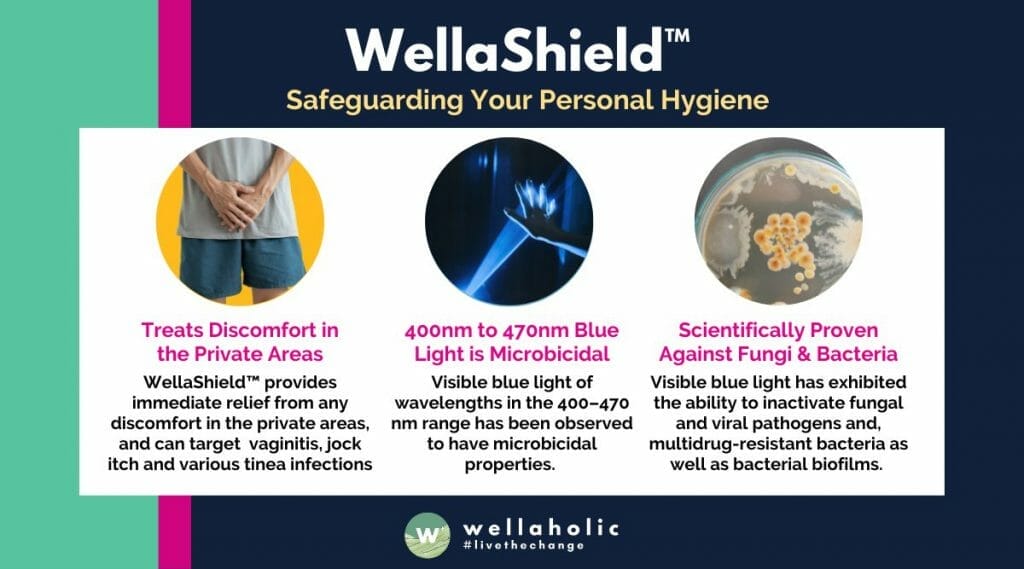
WellaShield™ is a blue-light device that can be used to improve genital hygiene, moisture, and comfort, and treat vaginal infections and jock itch. Blue-light has antimicrobial properties that can eliminate harmful bacteria and fungi, and stimulate the production of natural oils and moisture in the private areas.
- ⭐ Blue-Light Treatment for Genital Health: Blue-light has antimicrobial properties that can eliminate harmful bacteria and fungi in your private areas. By using WellaShield™, you can prevent infections and improve your genital hygiene.
- ⭐ Blue-Light Treatment for Moisture and Comfort: Blue-light can also stimulate the production of natural oils and moisture in your private areas. This can help you avoid dryness, discomfort, and itching that can affect your sexual health and well-being.
- ⭐ Blue-Light Treatment for Vaginitis: Vaginitis is a common condition that causes inflammation, irritation, and discharge in the vagina. WellaShield™ uses blue-light to target the source of the problem and reduce the symptoms. It can also restore the balance of the vaginal flora and pH level.
- ⭐ Blue-Light Treatment for Jock Itch: Jock itch is a fungal infection that causes a rash and itchiness in the groin and genitals. WellaShield™ uses blue-light to fight the fungus and bacteria that cause the infection. It can also soothe the skin and reduce the inflammation.


