


Why Does My Back and Neck Hurt After Sitting All Day? Singapore Guide (2026)
Why Does My Back And Neck Hurt After Sitting All Day? Singapore Guide (2026)
Why does my back and neck hurt after sitting all day?
Prolonged sitting keeps postural muscles in a continuous low-level contraction, which gradually depletes their oxygen supply and allows metabolic waste to accumulate deep within the muscle tissues. Wellaholic’s expert team commonly observes that while surface-level stretching provides temporary relief, addressing deep postural fatigue requires targeted stimulation that penetrates beneath the superficial muscle layers. This approach works best for individuals experiencing chronic desk-bound stiffness, though it cannot replace active ergonomic adjustments and regular movement. This targeted relief is highly beneficial for busy Singapore professionals seeking to manage daily physical strain amidst demanding work schedules.
Introduction
At the end of a long day of back-to-back video calls, a person reaches up to rotate their neck and feels the familiar stiffness lock in — that dense, unyielding tension just below the base of the skull and across the upper shoulders. The room has been air-conditioned all day, the laptop screen slightly too low, and the last stretch break was sometime before lunch. The massage booked for last Friday helped for about two days.
This pattern is recognisable to most Singapore office workers, and it is not a sign of poor posture habits alone. The mechanism behind persistent postural pain involves what happens to muscle tissue during sustained static loading — and why surface-level interventions address the symptom rather than the underlying fatigue accumulation. Understanding this distinction changes how the problem can be approached.
In this guide, Wellaholic’s expert team walks through why sitting all day damages muscles at the fibre level, why the pain returns after massage and stretching, what deep muscle stimulation does differently, and when professional muscle recovery treatment is worth considering.

Why Sitting All Day Damages Your Muscles — Not Just Your Posture
Most people associate desk-based discomfort with bad posture, but the deeper issue is what sustained static loading does to muscle tissue over hours. When the body holds a position without movement, certain postural muscles — particularly those supporting the neck, upper back, and lumbar spine — remain in continuous low-level contraction. This is not the same as exercise: there is no recovery phase, no alternation between contraction and release, just sustained effort with no rest.
Over time, this continuous contraction restricts local blood flow within the muscle tissue. Oxygen delivery slows, metabolic by-products accumulate, and the muscle fibres begin to fatigue without the person having done anything physically demanding. The result is the familiar aching, stiffness, and reduced range of movement that sets in by mid-afternoon and worsens by the time the workday ends.
In Singapore’s office environment, several factors compound this baseline load. Air-conditioned environments cause muscles to stay slightly contracted as the body manages temperature, adding background tension to already-fatigued postural muscles. Long MRT commutes in fixed standing or seated positions extend the total daily postural load beyond the office hours themselves.
The Difference Between Surface Tension and Deep Muscle Fatigue
What most people experience as “tight muscles” in the neck and upper back is actually a layered problem. The superficial muscles closest to the skin surface — those a massage therapist’s hands can directly reach — are one layer. Beneath them lie deeper postural muscles, including the multifidus, semispinalis, and deep cervical flexors, which are responsible for fine positional control and are the first to accumulate fatigue during sustained desk work.
Surface massage addresses the outer layers effectively and produces real relief — the problem is that the deep layer remains largely untouched. These deeper muscles are inaccessible to manual pressure alone, not because massage is ineffective but because the physical depth and specificity required exceeds what external pressure can achieve. The tension that returns within two or three days after a massage is typically originating from this deeper layer.
Work-from-home setups have made this worse for many Singapore professionals. Non-ergonomic dining chairs, laptops on coffee tables, and the absence of a standing desk option extend hours of suboptimal loading beyond what even a corporate office environment produces.

Why Massage and Stretching Provide Temporary Relief Only
Massage works by increasing local circulation, releasing surface myofascial tension, and activating the nervous system’s relaxation response. These are genuine physiological effects — the relief is real. The limitation is that these effects operate primarily at the tissue surface and through the autonomic nervous system, and they do not directly address the metabolic fatigue state of deep muscle fibres.
Stretching similarly works through the nervous system — reducing muscle spindle sensitivity and temporarily increasing the range of motion around a joint. It is a valuable maintenance tool, but it also does not penetrate to the deep fibre level where the accumulated fatigue is lodged. Many Singapore customers find that stretching during the workday helps manage acute discomfort but does not prevent the tension from returning by the following morning.
The fundamental issue is one of access. Both massage and stretching are effective for what they can reach. The problem that persists for most office workers is located in tissue layers that these interventions cannot directly address — which is why the cycle of temporary relief and returning discomfort continues regardless of how consistently they are applied.
What Deep Muscle Stimulation Does at the Fibre Level
High-intensity electromagnetic muscle stimulation works by inducing involuntary muscle contractions at a depth and intensity that voluntary movement and surface massage cannot replicate. The electromagnetic energy passes through the skin and surface tissue layers to directly stimulate motor neurons, triggering contractions in the deep muscle fibres where postural fatigue accumulates. This is not a surface vibration or heat effect — it is a direct neuromuscular response at depth.
These induced contractions have two effects relevant to postural fatigue recovery. First, the rapid alternation between contraction and release improves localised circulation in the deep tissue, clearing accumulated metabolic waste and restoring oxygen delivery to fatigued fibres. Second, the stimulation engages muscle groups that are difficult to activate voluntarily — particularly the deep stabilising muscles of the spine — supporting their recovery and functional tone.
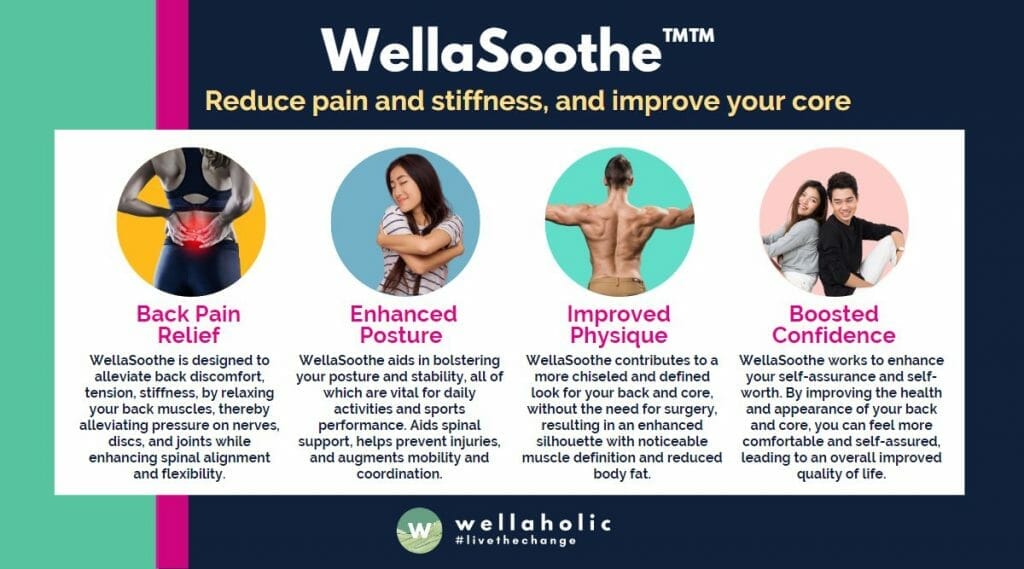
Wellaholic’s expert team uses this mechanism in WellaSoothe sessions to address the specific muscle groups most affected by sustained desk work. The approach targets the area of fatigue accumulation rather than the surface presentation of tension.

Who Is Most at Risk in Singapore’s Office Environment
Singapore’s working population sits among the most sedentary in Southeast Asia, with a large proportion spending eight to ten hours daily at a desk in CBD or heartland office environments. The combination of long office hours, air-conditioned environments, and extended MRT commutes creates a total daily postural load that is difficult to offset with short breaks or lunchtime stretching alone.
CBD professionals in particular face the additional constraint of limited lunch-hour time — physiotherapy sessions typically require 45–60 minutes minimum, which is impractical for most Tanjong Pagar or Raffles Place workers between 1pm and 2pm.
Work-from-home arrangements, while removing the commute, introduce different postural risks through improvised desk setups and a blurring of the boundary between sitting and resting that can extend total daily postural loading. Professionals who split their week between home and office often find that neither environment is optimally set up, compounding fatigue across the working week. Younger professionals in their late twenties and early thirties are increasingly presenting with postural tension patterns previously associated with older age groups, reflecting earlier onset of sedentary working habits.
People who carry stress primarily in the neck and upper trapezius — a common pattern in high-accountability roles across Singapore’s financial, legal, and tech sectors — tend to experience the most persistent and treatment-resistant postural tension. The chronic low-level contraction of the upper trapezius under sustained cognitive and emotional load adds a neurological dimension to the physical fatigue that surface interventions address only partially.
When to Consider Professional Muscle Recovery Treatment
Most office workers manage postural discomfort through massage, stretching, and occasional physiotherapy — and for mild or intermittent tension, this is appropriate. The signal that a different approach may be useful is when the relief cycle shortens: when the two or three days of relief from a massage become one day, or when the tension has stopped responding meaningfully to the interventions that used to work.
At this point, the deep muscle fatigue has likely progressed beyond what surface interventions alone can maintain. Professional muscle stimulation addresses the layer beneath — and many Singapore customers who have been managing recurring postural tension with massage alone find that adding deep stimulation sessions to their routine changes the duration and quality of relief they experience. This is not a replacement for massage or stretching but an addition that reaches where those approaches cannot.
The practical case for professional treatment also includes time. A WellaSoothe session at Wellaholic’s Kovan outlet — open until 10pm and accessible to heartland residents after work — fits into an end-of-day routine that a physiotherapy appointment typically cannot. For professionals who have struggled to maintain consistent physiotherapy attendance due to scheduling, a more accessible format can make the difference between consistent care and none at all.

WellaSoothe at Wellaholic: Deep Muscle Relief for Singapore’s Desk Workers
The gap between temporary surface relief and sustained muscle recovery is where WellaSoothe is positioned. Rather than addressing the surface presentation of tension, WellaSoothe uses high-intensity electromagnetic stimulation to reach the deep postural muscle fibres where office-related fatigue accumulates — the layer that massage and stretching cannot directly access. Sessions are available at all four Wellaholic outlets and require no preparation or recovery time.
A WellaSoothe session is conducted by Wellaholic’s expert team and targets the specific muscle groups identified during the initial assessment — typically the cervical extensors, upper trapezius, and lumbar paraspinals for desk workers presenting with postural fatigue. Sessions do not require any physical activity from the customer and can be scheduled during a lunch break or after work without affecting the rest of the day. Many Singapore customers use WellaSoothe as a regular maintenance tool between massage appointments rather than as a standalone replacement.
All prices below are GST-inclusive.
Per-Session Pricing
| Sessions | Price per Session |
| 1 Session | $249 |
| 3 Sessions | $237 |
| 6 Sessions | $224 |
| 12 Sessions | $199 |
No Afternoon Advantage applies to per-session treatments. For full pricing across Wellaholic’s body treatment range, visit the pricing page at /pricing/.
To discuss whether WellaSoothe is appropriate for your specific postural concerns, Wellaholic’s expert team is available for a no-obligation consultation at any of the four outlets — no commitment required at the first visit.
Customer Testimonial: WellaMuscle EMS Muscle Sculpting
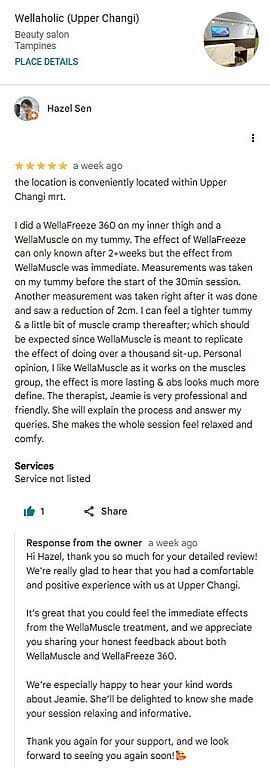
Hazel, a Wellaholic customer at our Upper Changi outlet, shares her experience with WellaMuscle™. Located within Upper Changi MRT, she found the outlet convenient for her appointment. During her visit, she tried WellaFreeze 360 on her inner thigh and WellaMuscle™ on her abdomen. While results from WellaFreeze take time, she noted her experience with WellaMuscle™ was immediate — measurements taken before and after the 30-minute session showed a 2cm difference, and she felt her abdomen was tighter with mild muscle sensation afterwards. Hazel shares that she prefers WellaMuscle™ as it works on the muscle groups, and found the definition more noticeable to her. The service at Upper Changi stood out for being professional and friendly. Our senior therapist explained the process, addressed her queries, and helped the session feel relaxed and comfortable. Hazel notes the overall experience at Wellaholic as one she would consider again.
Read Actual Review by Customer
“the location is conveniently located within Upper Changi mrt.
I did a WellaFreeze 360 on my inner thigh and a WellaMuscle on my tummy. The effect of WellaFreeze can only known after 2+weeks but the effect from WellaMuscle was immediate. Measurements was taken on my tummy before the start of the 30min session. Another measurement was taken right after it was done and saw a reduction of 2cm. I can feel a tighter tummy & a little bit of muscle cramp thereafter; which should be expected since WellaMuscle is meant to replicate the effect of doing over a thousand sit-up. Personal opinion, I like WellaMuscle as it works on the muscles group, the effect is more lasting & abs looks much more define. The therapist, Jeamie is very professional and friendly. She will explain the process and answer my queries. She makes the whole session feel relaxed and comfy.” (Source: Google Review)

Conclusion
Persistent back and neck pain from desk work is not a willpower problem or a posture habit that can be fixed by sitting up straighter. It is a physiological outcome of sustained static loading on deep postural muscle fibres — and it requires intervention at the depth where the fatigue originates, not just at the surface where the tension presents. For many Singapore professionals, adding deep muscle stimulation to an existing recovery routine changes what sustained management actually feels like.
WellaSoothe sessions are available across Wellaholic’s four outlets islandwide, designed to fit around Singapore’s working schedules. The Somerset outlet is a short walk from Somerset MRT in the Orchard area. The Tanjong Pagar outlet serves CBD professionals who need an option that fits within the working day. For those in the north-east, the Kovan outlet runs evening sessions accessible after office hours. The Upper Changi outlet sits directly within the MRT station for commuters heading home along the East-West line. Wellaholic’s expert team is available at each location for a no-pressure consultation to assess your postural fatigue pattern and recommend a starting point.
Key Takeaways
- Static loading is the core mechanism: Sustained seated posture holds postural muscles in continuous low-level contraction without a recovery phase, depleting local oxygen supply and accumulating metabolic waste in the deep tissue.
- Deep muscle fibres are the problem layer: The postural muscles most affected by desk work — deep cervical flexors, multifidus, deep spinal stabilisers — lie below the reach of surface massage and manual stretching.
- Massage and stretching address the surface: Both modalities produce genuine physiological relief but operate primarily on superficial tissue layers and the autonomic nervous system, not on the deep fibre level where fatigue is lodged.
- Electromagnetic stimulation reaches deeper: High-intensity electromagnetic energy bypasses the surface layers to directly stimulate motor neurons in deep muscle groups, inducing contractions that improve circulation and support recovery at the source of the fatigue.
- Singapore’s working environment compounds the load: Air-conditioned offices, long MRT commutes, non-ergonomic work-from-home setups, and constrained lunch-hour schedules create a total daily postural load that surface interventions alone often cannot keep pace with.
Frequently Asked Questions (FAQ)
Q1: What causes back and neck pain from sitting all day?
Prolonged sitting places postural muscles — particularly those in the neck, upper back, and lumbar spine — in sustained low-level contraction without a rest phase. Over hours, this restricts local blood flow, depletes oxygen supply, and allows metabolic by-products to accumulate in the deep tissue. The result is the progressive aching, stiffness, and reduced range of movement that develops across a typical Singapore office workday.
🔵 Static loading mechanism: Muscles held in continuous contraction without movement enter a fatigue state even without exertion.
🔵 Oxygen depletion: Sustained contraction restricts local blood flow, reducing the oxygen available to working muscle fibres.
🔵 Metabolic accumulation: Waste products from muscle activity accumulate in the tissue when circulation is restricted.
🔵 Deep fibre involvement: The deep postural muscles supporting spinal alignment are disproportionately affected by sustained desk posture.
🔵 Air-conditioning factor: Cool environments keep muscles in a mild background contraction state, adding to the total daily load.
🔵 Commute extension: MRT commutes in fixed seated or standing positions extend total postural loading beyond office hours.
Q2: Why does my muscle pain keep coming back after massage?
Massage effectively relieves surface myofascial tension and activates the body’s relaxation response, producing real and measurable relief. The limitation is that these effects operate primarily on the superficial tissue layers — the deep postural muscles where chronic fatigue accumulates remain largely untouched by external manual pressure. When the relief wears off within two to three days, the returning tension is typically originating from the deep layer that the massage did not directly reach.
🔵 Surface access limit: Manual massage pressure cannot reach the deep stabilising muscles of the cervical spine and lumbar region effectively.
🔵 Autonomic effect: Massage works partly through the nervous system’s relaxation response — an effect that fades as daily postural loading resumes.
🔵 Deep fibre residual fatigue: The metabolic fatigue state of deep fibres is not cleared by surface pressure alone.
🔵 Cycle pattern: The shortening of relief duration over time signals that deep fatigue is progressing beyond what surface treatment maintains.
🔵 Complementary role: Massage remains valuable for surface tension management — the gap is in reaching the deeper layer simultaneously.
🔵 Not a failure of massage: The return of tension is a function of tissue depth, not of massage quality or technique.
Q3: What is EMS muscle stimulation and how does it work?
Electromagnetic muscle stimulation uses high-intensity electromagnetic energy to induce involuntary muscle contractions at a depth that voluntary movement and surface massage cannot replicate. The energy passes through the skin and surface tissue to directly stimulate motor neurons in the deep muscle fibres, triggering a rapid alternation between contraction and release. This process improves localised circulation in the deep tissue, clears accumulated metabolic waste, and supports the recovery of muscle groups that sustained postural loading has fatigued.
🔵 Electromagnetic penetration: Energy passes through surface layers to stimulate motor neurons in deep muscle groups directly.
🔵 Involuntary contraction: Contractions are induced without voluntary effort, reaching fibres that active exercise often cannot isolate.
🔵 Contraction-release cycle: The rapid alternation between contraction and release mimics the recovery mechanics that static loading denies.
🔵 Circulation improvement: Deep tissue circulation is enhanced, clearing metabolic waste and restoring oxygen delivery to fatigued fibres.
🔵 Deep stabiliser access: Muscles like the multifidus and deep cervical flexors — inaccessible to surface massage — can be directly engaged.
🔵 No surface heat required: The mechanism is neuromuscular, not thermal — the effect is not dependent on heat penetration.
Q4: How is WellaSoothe different from physiotherapy or sports massage?
Physiotherapy addresses movement dysfunction, joint mechanics, and rehabilitation through manual therapy, exercise prescription, and biomechanical correction — a clinical scope that goes beyond muscle fatigue management. Sports massage targets the superficial and intermediate muscle layers through manual pressure and technique. WellaSoothe uses electromagnetic stimulation to reach the deep postural muscle fibres directly, complementing both approaches by addressing the layer below what hands and movement can access.
🔵 Depth of access: WellaSoothe reaches deep postural muscles that neither manual therapy nor stretching can directly stimulate.
🔵 Scope distinction: Physiotherapy addresses structural and biomechanical dysfunction; WellaSoothe focuses on deep muscle fatigue recovery.
🔵 No active effort required: Sessions are passive — the electromagnetic stimulation does the work without requiring physical exertion from the customer.
🔵 Time efficiency: A WellaSoothe session fits within a lunch break or post-work slot without the preparation or recovery time physiotherapy sometimes requires.
🔵 Maintenance tool positioning: Many customers use WellaSoothe between physiotherapy or massage appointments to maintain deep muscle recovery.
🔵 Non-invasive: No needles, manipulation, or physical pressure is applied — the electromagnetic energy works through the skin surface.
Q5: How many sessions does WellaSoothe typically require?
The number of sessions varies depending on the severity and duration of postural fatigue, individual muscle response, and how consistently sessions are maintained alongside other recovery habits. A fixed session count cannot be guaranteed — outcomes vary between individuals based on their specific fatigue pattern and lifestyle load. Many Singapore customers find that an initial course of sessions establishes a meaningful baseline, after which maintenance sessions at regular intervals support ongoing management.
🔵 No fixed count: Individual biological response and fatigue severity mean a universal session number cannot be promised.
🔵 Fatigue severity factor: Long-standing deep muscle fatigue typically requires more sessions to establish a recovery baseline than recent-onset tension.
🔵 Lifestyle load influence: Customers who continue high daily postural loading between sessions may find progress slower than those who also address ergonomic factors.
🔵 Initial course logic: An initial series of sessions allows the deep muscle tissue to respond cumulatively before a maintenance interval is established.
🔵 Maintenance positioning: WellaSoothe is most effective as a regular tool rather than a one-off intervention for chronic postural fatigue.
🔵 Expert assessment: Wellaholic’s expert team evaluates each customer’s starting point and progress at each visit to guide the approach.
Q6: Where can I try WellaSoothe in Singapore?
WellaSoothe is available at all four Wellaholic outlets across Singapore, each positioned to serve different parts of the island and different scheduling needs. No prior experience with muscle stimulation treatment is required — Wellaholic’s expert team conducts an initial assessment to understand the customer’s postural fatigue pattern and identify the target muscle groups before the first session begins. A no-obligation consultation is available at any outlet without requiring a commitment to a programme.
🔵 Somerset: Wellaholic’s flagship outlet, three minutes from Somerset MRT Exit B in the Orchard area.
🔵 Tanjong Pagar: CBD location at 210A Telok Ayer Street, accessible for lunch-hour appointments from Raffles Place and Tanjong Pagar MRT.
🔵 Kovan: Heartland outlet open until 10pm, serving north-east Singapore residents who prefer post-work appointments.
🔵 Upper Changi: Located inside Upper Changi MRT station at platform level — convenient for East-West line commuters.
🔵 No commitment required: The first visit is a consultation and assessment — customers are not required to commit to a plan before trying a session.
🔵 Walk-ins welcome: Sessions can be booked online or arranged at the outlet directly without a referral.

About Wellaholic’s Expert Team
Wellaholic’s treatments are designed and overseen by our founding team, whose qualifications include a CIDESCO Diploma in Aesthetics and a Level 3 Certification in Beauty Therapy & Salon Management from Brentwood College UK. With hands-on experience across IPL, SHR hair removal, and a wide range of aesthetic treatments, our founders bring both academic grounding and practical expertise to every service protocol at Wellaholic.
Our Aesthetic Director holds a CIDESCO certificate in skin care and a Bachelor of Health Science (Aesthetics) from Torrens University of Australia, with over a decade of industry experience spanning Singapore and Australia. Her background includes a senior role at a leading laser aesthetics group, giving her deep insight into safe and effective treatment delivery across diverse skin types.
Together, Wellaholic’s expert team has served over 18,000 customers across four outlets in Singapore — Somerset, Tanjong Pagar, Kovan, and Upper Changi — and has been recognised at the Beauty Insider and Daily Vanity Awards.
Contact us at support.
GET IN TOUCH
Book Now Pay Later
WellaSoothe™ – Advanced Pain Relief Technology
🔵 FDA-Approved Electromagnetic Therapy Delivers Immediate Pain Relief Results
🔵 Professional Athletes Trust Our Technology for Fast Recovery
🔵 Treats Multiple Pain Conditions in Just 30 Minutes
🔵 Zero Recovery Time: Return to Activities Immediately After
🔵 Strengthens Muscles While Breaking Down Painful Scar Tissue
🔵 Trusted by 13,000+ Customers with Documented Success Stories
🔵 Personalized Treatment Plans Adapt to Your Pain Management Needs