


Why Does My Muscle Tension Keep Coming Back? A Singapore Guide (2026)
A Singapore Guide 2026: The Best Aesthetic Treatments For Your Skin & Body
Why do muscle tightness and discomfort persist even after a massage?
Chronic muscle tension stems from sustained motor neuron activation and deep connective tissue adaptations that surface-level massage cannot easily reach or reset. Wellaholic’s expert team commonly observes that addressing deep-seated tension requires targeted, consistent physical therapies rather than occasional relaxation treatments. While these advanced approaches work best for individuals experiencing posture-related stiffness, they cannot instantly reverse years of structural misalignment without lifestyle adjustments. This targeted relief is highly beneficial for busy Singapore professionals seeking efficient, effective recovery options that fit seamlessly into their demanding work schedules.

Introduction
Lying face-down on the massage table on a Sunday afternoon, a familiar thought surfaces somewhere around the twenty-minute mark: this will feel better for three days. By Wednesday the tension will be back in exactly the same place — the same knot at the base of the right shoulder, the same tightness across the upper back — as though the massage never happened. The therapist is skilled. The session is thorough. The relief is real. And then Monday resets everything.
This is not a failure of massage, and it is not a failure of effort. Chronic muscle tension that returns reliably after treatment is a physiological pattern with a specific mechanism — one that operates at a layer below what surface interventions are designed to address. Understanding why the tension keeps coming back is the first step toward managing it more effectively, rather than cycling through the same temporary relief indefinitely.
In this guide, Wellaholic’s expert team walks through what is actually happening in a chronically tense muscle, why massage and stretching address the symptom rather than the pattern, what role the nervous system plays in persistent tension, and what deeper muscle intervention targets that surface treatments cannot reach.

Acute Soreness vs Chronic Tension: Why They Are Not the Same Problem
Acute muscle soreness — the kind that follows a hard training session or an unaccustomed physical effort — is a temporary state tied to a specific cause. The tissue is inflamed, the nerve endings are sensitised, and the soreness resolves as the repair process completes. It has a beginning, a peak, and an end that corresponds to the healing timeline of the affected tissue.
Chronic muscle tension does not follow this pattern. It is not the aftermath of a specific event — it is a sustained state that the muscle has settled into, often over weeks or months of accumulated loading, stress, or postural habit. The muscle fibres are not acutely damaged in the same way; instead, they are held in a state of continuous partial contraction driven by persistent motor neuron activation that does not switch off between demands.
This distinction matters because it changes what intervention is appropriate. Treatments designed for acute recovery — rest, ice, anti-inflammatory approaches — address the inflammatory aftermath of tissue damage. They do not interrupt a sustained motor neuron firing pattern or reverse connective tissue changes that have developed over time.
Applying an acute-recovery framework to a chronic tension pattern is one reason why the relief from each massage or heat pack session tends to be shorter than expected.

What Is Actually Happening in a Chronically Tense Muscle?
In a muscle that has been chronically tense for weeks or months, several physiological changes accumulate beyond simple tightness. The sustained partial contraction restricts local blood flow, reducing oxygen delivery to the affected fibres and allowing metabolic waste products to accumulate in the tissue. Over time, the connective tissue surrounding the muscle fibres — the fascia — begins to adapt to the shortened, contracted state, losing some of its normal extensibility.
Motor neuron firing patterns also adapt. When a muscle group is consistently activated at low levels over extended periods — as happens with postural holding, stress-driven bracing, or repetitive occupational movements — the motor neurons supplying those fibres can become sensitised, maintaining a lower threshold for activation. This means the muscle tends to contract more readily and more persistently in response to even minor triggers, creating a self-reinforcing cycle of tension and sensitisation.
The combination of restricted circulation, connective tissue adaptation, and lowered motor neuron thresholds means that chronic tension is structurally embedded rather than simply present on the surface.
A massage session that effectively releases surface myofascial tension does not reset the motor neuron firing pattern or restore the deep tissue’s circulatory environment to a healthy baseline. The tension returns because the underlying pattern has not been addressed.

Why Massage, Heat, and Stretching Provide Temporary Relief Only
Massage works on the surface and intermediate tissue layers through manual pressure, myofascial release, and the autonomic nervous system’s relaxation response. The relief it produces is genuine — local circulation improves, surface adhesions release, and the parasympathetic activation during a session reduces overall muscle tone temporarily. For acute tension or mild chronic tightness in accessible muscle groups, this is often sufficient.
Heat application dilates blood vessels, increases local tissue temperature, and temporarily reduces the sensitivity of muscle spindles — the sensory organs within muscle fibres that regulate contraction. The relief is real but brief, because neither the connective tissue adaptation nor the motor neuron sensitisation is changed by surface warming. The muscle returns to its established pattern as the thermal effect fades.
Stretching works through the nervous system by reducing muscle spindle sensitivity and temporarily increasing the range of motion around a joint. Consistent stretching over time can produce meaningful improvements in flexibility, but it does not directly address the deep fibre layer where sustained motor activation is concentrated, and it does not restore circulation to the tissue environment that chronic partial contraction has depleted.
Many Singapore customers find that stretching during the workday provides some relief in the moment but does not prevent the tension from resetting overnight.

The Role of Stress and the Nervous System in Persistent Muscle Tension
Sustained sympathetic nervous system activation — the physiological state associated with ongoing stress, high cognitive load, and always-on professional demands — has a documented association with elevated resting muscle tone. When the body is in a sustained state of readiness, postural muscles tend to remain partially contracted as part of the preparatory response. In Singapore’s high-accountability professional environment, where cognitive and deadline pressure rarely fully switch off between working hours, this background activation can become a persistent contributor to muscle tension.
This does not mean that stress is the sole cause of chronic tension, and it is not a medical diagnosis. What it does mean is that chronic tension in Singapore professionals often has a neurological component alongside the physical — the sustained low-level bracing pattern driven by sympathetic activation adds to whatever postural or occupational loading the person is also carrying. Addressing only the physical layer of the tension, without acknowledging this neurological contributor, is another reason why surface-only interventions produce shorter relief windows than expected.
Managing this pattern over time involves both addressing the physical tissue layer and supporting the nervous system’s recovery — through adequate sleep, genuine rest periods, and reducing the total accumulated stress load where possible.
Professional muscle treatment fits into this picture as a tool that addresses the physical tissue layer more deeply than surface interventions, while the nervous system component benefits from the same lifestyle management that supports overall health. Neither alone resolves the pattern completely for most people — which is why the framing of maintenance rather than cure is more honest and more useful.

What Deep Muscle Stimulation Targets That Surface Treatments Cannot Reach
High-intensity electromagnetic muscle stimulation reaches the deep muscle fibres and the motor neuron activation patterns within them by delivering energy through the surface and intermediate tissue layers directly to the neuromuscular level. The induced contractions are involuntary and occur at a depth that neither foam rolling nor manual massage can produce — this means the deep fibres involved in chronic tension patterns are engaged and cycled through contraction and release rather than remaining in their sustained partial contraction state.
The circulation effect at this depth is practically significant for chronic tension. The restricted blood flow caused by sustained partial contraction is one of the key mechanisms that perpetuates the tension pattern — the depleted tissue environment reduces the muscle’s ability to recover between demands. Deep electromagnetic stimulation drives a pump effect in this depleted tissue layer, improving the delivery of oxygen and clearance of accumulated metabolic waste more effectively than surface massage can achieve in the same tissue zone.
The connective tissue adaptation that develops in chronically tense muscles is not reversed in a single session, and Wellaholic’s expert team does not position WellaSoothe as a cure for chronic tension. What regular sessions provide is consistent engagement of the deep tissue layer — interrupting the sustained contraction pattern, improving the circulatory environment, and supporting the muscle’s capacity to recover between the demands that keep reactivating the tension.
Many Singapore customers find that regular sessions help manage recurring tension as part of a broader maintenance routine alongside massage, stretching, and lifestyle adjustments.

Building a Sustainable Muscle Maintenance Routine in Singapore
For most people with chronic muscle tension, no single intervention resolves the pattern permanently. The most practical approach is a layered maintenance routine that addresses different aspects of the problem with appropriate tools — surface tension management through massage or stretching, deep tissue stimulation for the fibre-level layer, and lifestyle management for the neurological component. The goal is reducing the frequency and severity of tension recurrence rather than expecting a final resolution.
In Singapore’s context, the practical challenge is building a maintenance routine that is sustainable within the constraints of a working week. Physiotherapy is effective for structural assessment and rehabilitation but typically requires dedicated appointment blocks that mid-week schedules struggle to accommodate consistently. Massage is more accessible but, as established, addresses the surface layer only. A WellaSoothe session at Wellaholic’s Tanjong Pagar outlet — located in the CBD and accessible during lunch hours from Raffles Place and Tanjong Pagar MRT — fits into a working day in a way that a longer physiotherapy appointment often cannot.
The most sustainable maintenance routines are the ones that actually happen consistently. For chronic tension management, consistency across weeks and months matters more than the intensity of any single intervention. Building a realistic schedule — perhaps a monthly or fortnightly professional session alongside daily stretching and periodic massage — is more effective over time than intensive bursts of treatment followed by extended gaps.

WellaSoothe at Wellaholic: Deep Muscle Maintenance for Singapore’s Chronic Tension Patterns
For people managing recurring muscle tension, WellaSoothe addresses the layer that surface interventions do not reach — the deep muscle fibres and motor neuron patterns where chronic tension is structurally embedded. Rather than positioning itself as a cure, WellaSoothe is most accurately described as a maintenance tool: a regular addition to a broader routine that keeps the deep tissue layer from accumulating the kind of sustained contraction pattern that produces chronic tension in the first place. Sessions are conducted by Wellaholic’s expert team at all four outlets with no preparation or recovery time required.
An initial session begins with an assessment of the tension pattern — which muscle groups are most chronically activated, what the customer’s daily load looks like, and what other recovery tools are already in use. Wellaholic’s expert team then directs the electromagnetic stimulation to the specific muscle groups identified, allowing the deep tissue intervention to be targeted rather than generic. Many Singapore customers managing chronic tension use WellaSoothe on a regular schedule — monthly or fortnightly — as a maintenance investment rather than a reactive response to peak tension.
All prices below are GST-inclusive.
Per-Session Pricing
| Sessions | Price per Session |
| 1 Session | $249 |
| 3 Sessions | $237 |
| 6 Sessions | $224 |
| 12 Sessions | $199 |
No Afternoon Advantage applies to per-session treatments. For the full range of Wellaholic body treatment pricing, visit /pricing/.
Wellaholic’s expert team is available for a no-obligation consultation at any outlet to assess whether WellaSoothe is appropriate for your specific tension pattern and maintenance goals. No commitment is required at the first visit.

Customer Testimonial: WellaMuscle EMS Muscle Sculpting
Hazel, a Wellaholic customer at our Upper Changi outlet, shares her experience with WellaMuscle™. Located within Upper Changi MRT, she found the outlet convenient for her appointment. During her visit, she tried WellaFreeze 360 on her inner thigh and WellaMuscle™ on her abdomen. While results from WellaFreeze take time, she noted her experience with WellaMuscle™ was immediate — measurements taken before and after the 30-minute session showed a 2cm difference, and she felt her abdomen was tighter with mild muscle sensation afterwards. Hazel shares that she prefers WellaMuscle™ as it works on the muscle groups, and found the definition more noticeable to her. The service at Upper Changi stood out for being professional and friendly. Our senior therapist explained the process, addressed her queries, and helped the session feel relaxed and comfortable. Hazel notes the overall experience at Wellaholic as one she would consider again.
Read Actual Review by Customer
“the location is conveniently located within Upper Changi mrt.
I did a WellaFreeze 360 on my inner thigh and a WellaMuscle on my tummy. The effect of WellaFreeze can only known after 2+weeks but the effect from WellaMuscle was immediate. Measurements was taken on my tummy before the start of the 30min session. Another measurement was taken right after it was done and saw a reduction of 2cm. I can feel a tighter tummy & a little bit of muscle cramp thereafter; which should be expected since WellaMuscle is meant to replicate the effect of doing over a thousand sit-up. Personal opinion, I like WellaMuscle as it works on the muscles group, the effect is more lasting & abs looks much more define. The therapist, Jeamie is very professional and friendly. She will explain the process and answer my queries. She makes the whole session feel relaxed and comfy.” (Source: Google Review)

Conclusion
Chronic muscle tension that returns reliably after every massage is not a sign that the treatment is failing — it is a sign that the pattern producing the tension is operating at a layer below what surface treatment addresses. Managing it sustainably means acknowledging that it requires ongoing maintenance rather than a single intervention, and building a routine that consistently reaches the deep tissue layer where the tension is structurally embedded.
Wellaholic’s WellaSoothe sessions are available at all four outlets across Singapore, structured around the working schedules that characterise most of the people experiencing this pattern. The Somerset outlet is convenient for those in the Orchard and Dhoby Ghaut area. The Tanjong Pagar outlet serves CBD professionals who need an option within the working day. The Kovan outlet is open until 10pm for north-east residents who prefer evening sessions. The Upper Changi outlet is located directly inside the MRT station for East-West line commuters. Wellaholic’s expert team is available at each location for a no-pressure conversation about where WellaSoothe fits into your current maintenance routine.
Key Takeaways
- Chronic tension is physiologically distinct from acute soreness: It involves sustained motor neuron activation, connective tissue adaptation, and a depleted deep tissue circulatory environment — not simply the aftermath of a specific physical event.
- Surface treatments address where tension presents, not where it originates: Massage, heat, and stretching work on the superficial and intermediate tissue layers; the deep fibre and motor neuron patterns where chronic tension is embedded lie below their reliable reach.
- Stress and sustained sympathetic activation contribute to the pattern: Singapore’s high-accountability professional environment maintains a background level of nervous system activation that elevates resting muscle tone and shortens the effective relief window from surface treatments.
- Deep electromagnetic stimulation reaches the embedded layer: High-intensity electromagnetic energy induces involuntary contractions in deep muscle fibres, interrupting the sustained partial contraction pattern and driving circulation improvement in the tissue layer that surface massage cannot access.
- Maintenance rather than cure is the honest framing: Chronic tension managed well requires a consistent layered routine — deep stimulation for the fibre level, massage for the surface, lifestyle management for the neurological component — sustained over weeks and months rather than resolved in a single intervention.
Frequently Asked Questions (FAQ)
Q1: What is the difference between muscle soreness and chronic muscle tension?
Acute muscle soreness is tied to a specific cause — training, unaccustomed exertion, or an acute physical demand — and resolves as the tissue heals over a predictable timeframe. Chronic muscle tension is a sustained state that the muscle has settled into over weeks or months, driven by persistent motor neuron activation rather than acute tissue damage. The two require different approaches because the underlying physiological mechanisms are distinct.
🔵 Cause distinction: Acute soreness follows a specific event; chronic tension develops from sustained loading, postural habit, or neurological patterns over time.
🔵 Timeline difference: Acute soreness has a predictable resolution window; chronic tension does not resolve on a set timeline without addressing the underlying pattern.
🔵 Motor neuron involvement: Chronic tension involves sustained low-level motor neuron activation that keeps the muscle in partial contraction independently of acute demand.
🔵 Connective tissue adaptation: Over weeks and months, the fascia surrounding chronically tense muscle fibres adapts to the shortened state, reducing extensibility.
🔵 Treatment implications: Acute soreness responds to rest and circulation support; chronic tension requires intervention at the motor neuron and deep fibre level.
🔵 Pattern recognition: The reliable return of tension to the same location after each massage is a strong indicator of a chronic pattern rather than acute soreness.
Q2: Why does my muscle tension always come back after massage?
Massage effectively addresses the surface and intermediate tissue layers — releasing myofascial adhesions, improving local circulation at the surface level, and activating the autonomic relaxation response. What it does not do is interrupt the sustained motor neuron firing pattern or restore the deep tissue circulatory environment that chronic partial contraction has depleted. The tension returns because the mechanism producing it operates at a layer the massage did not directly reach.
🔵 Layer access limit: Manual pressure reliably reaches the superficial and intermediate muscle layers — the deep fibre level where chronic tension is embedded lies below consistent manual access.
🔵 Motor neuron pattern persistence: The lowered activation threshold of chronically sensitised motor neurons is not reset by surface myofascial release.
🔵 Connective tissue rebound: Fascial adaptation to the contracted state means the tissue tends to return toward its established shortened configuration after temporary release.
🔵 Circulatory environment: The depleted blood flow environment in the deep tissue is not fully restored by surface circulation improvements alone.
🔵 Not a massage failure: The return of tension reflects a depth limitation, not a quality problem with the massage or the therapist’s technique.
🔵 Complementary approach: Adding deep muscle stimulation to a maintenance routine addresses the layer that massage cannot reach, extending the relief window.
Q3: Can stress cause physical muscle tension?
Sustained sympathetic nervous system activation — the physiological state associated with ongoing stress, high cognitive load, and chronic deadline pressure — is commonly observed alongside elevated resting muscle tone. When the body maintains a state of readiness over extended periods, postural muscles tend to remain partially contracted as part of that preparatory response. In Singapore’s professional environment, where this background activation rarely fully switches off, stress is a commonly observed contributor to persistent muscle tension patterns.
🔵 Sympathetic activation mechanism: Sustained stress keeps the nervous system in a preparatory state that elevates resting muscle tone across postural muscle groups.
🔵 Observational framing: The stress-tension link is a commonly observed pattern — Wellaholic’s expert team describes this as a physiological association, not a medical diagnosis.
🔵 Singapore context: Long working hours, commute load, and always-on professional expectations maintain background sympathetic activation that compounds physical tension.
🔵 Not the sole cause: Stress contributes to but does not fully explain chronic tension — postural, occupational, and biomechanical factors also play a role.
🔵 Lifestyle management relevance: Sleep, genuine rest periods, and stress reduction support the neurological component of chronic tension alongside physical intervention.
🔵 Combined approach: Addressing the physical tissue layer through deep stimulation alongside lifestyle management for the neurological component is more effective than either alone.
Q4: What does deep muscle stimulation do that massage cannot?
Deep electromagnetic muscle stimulation reaches the motor neurons supplying the deep muscle fibres directly, inducing involuntary contractions at a depth that manual pressure cannot reliably access. In the context of chronic tension, this interrupts the sustained partial contraction pattern — cycling the deep fibres through contraction and release rather than leaving them in the activated state that the chronic pattern maintains. The circulation improvement this produces at the deep tissue level addresses the depleted blood flow environment that sustained partial contraction has created.
🔵 Motor neuron access: Electromagnetic energy stimulates motor neurons in the deep fibres directly, bypassing the surface and intermediate layers.
🔵 Pattern interruption: The induced contraction-release cycle breaks the sustained partial contraction that characterises chronic tension at the fibre level.
🔵 Deep circulation restoration: The pump effect from rapid contractions improves blood flow in the deep tissue zone where restricted circulation perpetuates the tension pattern.
🔵 Connective tissue environment: Improved deep circulation supports the tissue environment in which connective tissue adaptation occurs, contributing to better extensibility over time.
🔵 No surface manipulation required: The electromagnetic energy reaches the target depth without physical pressure — the mechanism is neuromuscular, not compressive.
🔵 Maintenance application: Regular sessions keep the deep tissue layer from resettling into the sustained contraction state between surface-level maintenance treatments.
Q5: How often should I consider professional muscle recovery treatment?
For chronic tension management, consistency over time matters more than the frequency of any single period of intensive treatment. Many Singapore customers managing recurring tension find a monthly or fortnightly schedule of WellaSoothe sessions, combined with regular massage and daily stretching, provides more sustained management than less frequent intensive bursts. The appropriate interval depends on the severity of the tension pattern, the daily loading the person is under, and what other recovery tools are already in use.
🔵 Maintenance framing: Regular sessions at a sustainable interval are more effective for chronic tension than reactive treatment after peaks.
🔵 Individual loading factor: Customers under higher daily postural or stress loading may benefit from more frequent sessions than those with lower baseline demands.
🔵 Layered routine logic: WellaSoothe works best as one layer in a broader routine — the interval should be set in the context of what else is in the maintenance plan.
🔵 No fixed prescription: Wellaholic’s expert team assesses each customer’s pattern and recommends a starting interval based on their specific tension profile.
🔵 Progress adjustment: The interval can be extended as the tension pattern stabilises, or increased during periods of higher loading.
🔵 Consultation starting point: The first visit is a no-obligation assessment — commitment to a schedule comes after the initial evaluation, not before.
Q6: Where can I find WellaSoothe treatment in Singapore?
WellaSoothe is available at all four Wellaholic outlets across Singapore, each positioned to serve different parts of the island and different scheduling patterns. Wellaholic’s expert team conducts an initial tension assessment at the first visit to understand the chronic pattern and identify the specific muscle groups most in need of deep stimulation. A no-obligation consultation is available at any outlet without requiring commitment to a programme.
🔵 Somerset: Flagship outlet, three minutes from Somerset MRT Exit B in the Orchard area — convenient for central Singapore residents and professionals.
🔵 Tanjong Pagar: CBD outlet at 210A Telok Ayer Street, Level 2 — accessible during lunch hours from Raffles Place and Tanjong Pagar MRT stations.
🔵 Kovan: Heartland outlet open until 10pm — serves north-east Singapore residents who prefer post-work appointments without CBD travel.
🔵 Upper Changi: Located inside Upper Changi MRT station at platform level — convenient for East-West line commuters integrating treatment into their commute home.
🔵 No prior experience required: First-time customers receive a full explanation of the electromagnetic stimulation process before the session begins.
🔵 Flexible scheduling: Sessions can be booked online or arranged at the outlet directly without a referral or advance notice at most locations.

About Wellaholic’s Expert Team
Wellaholic’s treatments are designed and overseen by our founding team, whose qualifications include a CIDESCO Diploma in Aesthetics and a Level 3 Certification in Beauty Therapy & Salon Management from Brentwood College UK. With hands-on experience across IPL, SHR hair removal, and a wide range of aesthetic treatments, our founders bring both academic grounding and practical expertise to every service protocol at Wellaholic.
Our Aesthetic Director holds a CIDESCO certificate in skin care and a Bachelor of Health Science (Aesthetics) from Torrens University of Australia, with over a decade of industry experience spanning Singapore and Australia. Her background includes a senior role at a leading laser aesthetics group, giving her deep insight into safe and effective treatment delivery across diverse skin types.
Together, Wellaholic’s expert team has served over 18,000 customers across four outlets in Singapore — Somerset, Tanjong Pagar, Kovan, and Upper Changi — and has been recognised at the Beauty Insider and Daily Vanity Awards.
Contact us at support.
GET IN TOUCH
Book Now Pay Later

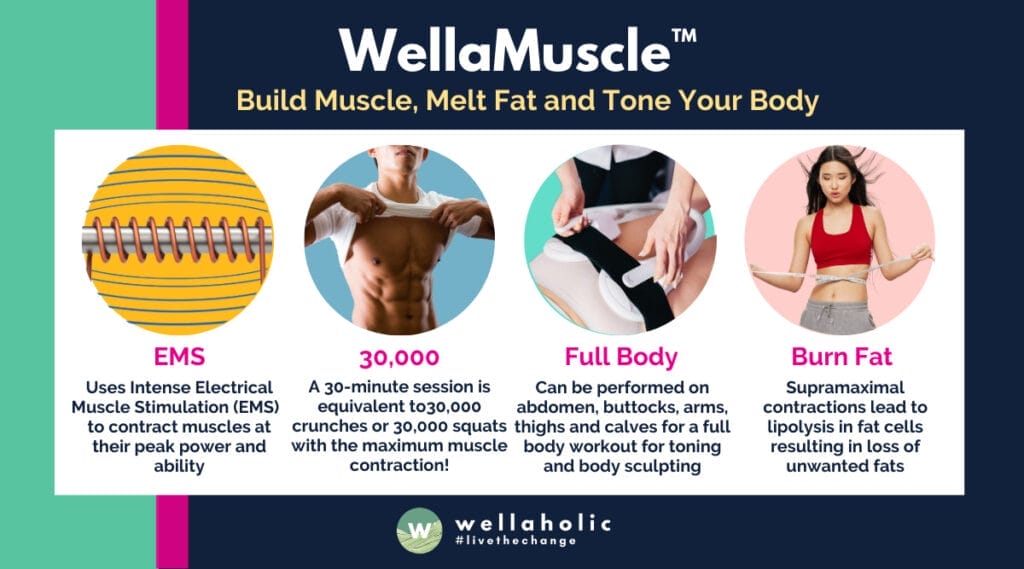
WellaMuscle™ – Build Muscle, Melt Fat & Tone Your Body
- ⭐ HI-EMT Technology. WellaMuscle™ uses High-Intensity Electromagnetic Technolog (HI-EMT) to stimulate muscle contractions and burn fat cells in targeted areas of the body.
- ⭐ 16.3% Increase in Muscle Mass. According to clinical studies, treatments like WellaMuscle™ can help you gain up to 16.3% more muscle mass in the treated areas after four sessions.
- ⭐ Effective on Abs, Buttocks, Arms, Thighs and Calves. WellaMuscle™ is effective on the large muscle groups of the abdomen and buttocks, as well as the smaller muscle groups of the arms, thighs, and calves.
- ⭐ Award-Winning. Wellaholic’s treatments have been recognized by top beauty publications such as Daily Vanity, Beauty Insider, and Tropika Club Magazine.
- ⭐ Over 2000 Verified Customer Reviews. Wellaholic has over 2000 positive reviews from customers, and >50% are repeat customers.