


Muscle Soreness After the Gym: What Actually Works for Recovery in Singapore (2026)
Muscle soreness after the gym: What does it mean?
How do you relieve muscle soreness after the gym?
Delayed onset muscle soreness (DOMS) involves microscopic muscle fibre tears and localised inflammation, which can be relieved through deep electromagnetic muscle stimulation that actively enhances circulation and cellular-level tissue repair. Wellaholic’s expert team commonly observes that high-intensity electromagnetic energy significantly accelerates recovery times compared to passive rest. While this technology works best for active individuals seeking faster turnaround between intense workouts, it cannot replace proper hydration and basic nutritional intake. This advanced recovery method is highly suited for busy Singapore professionals balancing demanding corporate schedules with intense fitness regimes.

Introduction
The morning after a heavy leg session, the quads announce themselves before the feet hit the floor. Navigating the HDB stairwell becomes a negotiation, and the MRT commute — standing, shifting weight, bracing for stops — is a reminder of every working set from the night before. For anyone who trains consistently, this is a familiar calculus: push hard enough to progress, manage the recovery well enough to train again on schedule.
DOMS is not an injury and it is not a sign that something went wrong. It is the physiological cost of training at an intensity that produces adaptation — the micro-damage that, once repaired, leaves the muscle fibre stronger. The question for Singapore gym-goers who train three or four times a week is not how to avoid DOMS but how to support the repair process efficiently so that recovery does not become the limiting factor on training frequency and quality.
In this guide, Wellaholic’s expert team walks through what DOMS is at the fibre level, what foam rolling and massage actually do, what deep muscle stimulation adds to the recovery process, and when professional treatment is worth building into a training routine.

What Is DOMS and Why Does It Happen?
Delayed onset muscle soreness is the result of eccentric muscle contractions — the lengthening-under-load phase of movements like squats, deadlifts, running downhill, and the lowering portion of any resistance exercise. These contractions generate mechanical stress on the muscle fibre structure, producing microscopic tears in the sarcomeres — the basic contractile units of the muscle. This is not pathological damage; it is the precise stimulus that triggers the muscle’s adaptive repair response.
The soreness itself does not come from lactic acid, which clears from the muscle within an hour of exercise. It comes from the inflammatory cascade that follows the micro-trauma — prostaglandins, cytokines, and localised fluid accumulation in the damaged tissue sensitise the surrounding nerve endings and produce the characteristic aching and stiffness. This process typically peaks between 24 and 48 hours post-exercise, which is why the worst soreness usually arrives the morning after rather than immediately following training.
In Singapore’s climate, heat and humidity add a compounding layer. Training in a warm environment increases core temperature and cardiovascular load, accelerating muscle fatigue during the session itself and leaving the tissue in a more depleted state going into the recovery window. The combination of training stress and ambient heat means Singapore gym-goers often experience more pronounced DOMS than counterparts training in cooler environments at equivalent intensities.
Why Rest Alone Is Not Always Enough
Complete rest allows the inflammatory repair process to proceed at its natural pace — which for most people means two to four days before the affected muscle group feels fully functional again. For someone training three to four times a week across multiple muscle groups, this creates a scheduling problem: the recovery timeline from one session frequently overlaps with the next, compressing the window of full capacity available for quality training.
Passive rest also does nothing to actively support the repair mechanisms themselves. The inflammatory response that drives DOMS recovery depends on adequate blood flow to deliver repair substrates — oxygen, glucose, amino acids — to the damaged tissue and clear inflammatory mediators from it. Extended inactivity reduces local circulation, which does not accelerate this process and may slow it.
Active recovery — light movement, walking, low-intensity cycling — has a stronger evidence base for supporting DOMS recovery than complete rest precisely because it maintains circulation without adding further mechanical stress to the damaged tissue. The principle is to keep blood moving through the recovering muscle without loading the sarcomeres that are still undergoing repair. Singapore’s ActiveSG gym network and the prevalence of boutique recovery studios have made active recovery options more accessible, but the depth to which circulation is supported matters as much as the activity itself.

What Foam Rolling and Massage Actually Do — and What They Don’t
Foam rolling and sports massage work through overlapping but distinct mechanisms. Foam rolling applies compressive pressure to the myofascial layer — the connective tissue surrounding the muscle — releasing surface adhesions and temporarily reducing the neural sensitivity of the muscle spindles. The relief is real and the technique is well-supported for reducing the subjective perception of soreness and improving short-term range of motion.
Sports massage goes deeper than foam rolling, reaching intermediate muscle layers through manual pressure, friction, and technique. It improves local circulation in the treated area, reduces myofascial tension, and activates the parasympathetic nervous system’s recovery response. Many gym-goers in Singapore use post-training massage as a standard recovery tool, and for surface and intermediate muscle tension, it is effective.
The limitation of both approaches is depth. The deep muscle fibres — particularly in large muscle groups like the quadriceps, hamstrings, and glutes — lie beyond the reliable reach of foam rollers and massage hands. Surface and intermediate relief does not clear the metabolic environment or support circulation in the deepest tissue layers where DOMS is most concentrated after heavy compound training. This is the gap that deeper stimulation addresses.
How EMS Deep Muscle Stimulation Supports the Recovery Process
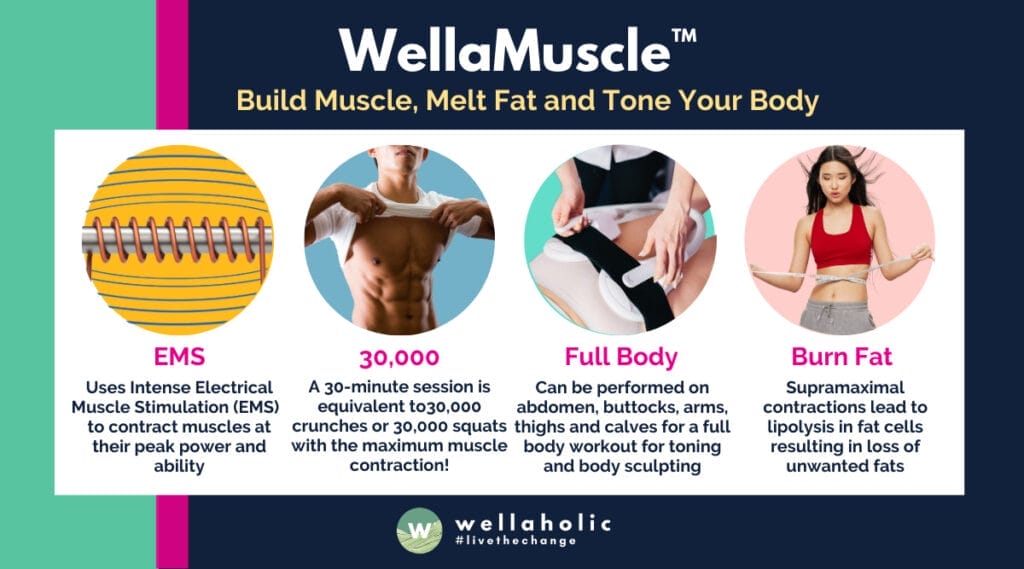
High-intensity electromagnetic muscle stimulation induces involuntary contractions at a depth that neither foam rolling nor manual massage can replicate. The electromagnetic energy passes through the surface and intermediate tissue layers to directly stimulate motor neurons in the deep muscle fibres, producing rapid alternating contractions and releases at the level where DOMS-related inflammation and repair activity is concentrated. This is not a surface vibration or thermal effect — it is a direct neuromuscular response at depth.
The recovery mechanism works through two primary pathways. First, the induced contractions drive a pump effect in the deep tissue — the rapid alternation between contraction and release significantly increases local circulation, delivering repair substrates to the damaged fibres and clearing inflammatory mediators from the tissue more efficiently than passive rest or surface massage achieves. Second, the neuromuscular stimulation engages the deep stabilising muscles that heavy compound training taxes most heavily but that surface-level recovery tools rarely reach.
Wellaholic’s expert team applies this mechanism in WellaSoothe sessions specifically to the muscle groups identified as most fatigued — quadriceps and hamstrings after leg sessions, thoracic and lumbar paraspinals after deadlifts and rows, pectorals and anterior deltoids after push days. The targeting is specific to the training pattern rather than generic, which means the stimulation reaches the tissue where active repair is underway.

Active Recovery vs Passive Recovery: What Singapore Gym-Goers Should Know
The evidence base for active recovery consistently shows advantages over complete rest for DOMS management — better circulation maintenance, faster clearance of inflammatory mediators, and reduced subjective soreness ratings at 48 and 72 hours. The practical challenge for Singapore gym-goers is finding active recovery options that fit into a working week without adding significant time or travel burden. A 60-minute sports massage requires booking, travel, and a block of time that mid-week schedules often cannot accommodate.
Professional muscle stimulation sessions fit differently into a recovery schedule. A WellaSoothe session can be completed in a lunch break or after work without requiring physical exertion or preparation — the electromagnetic stimulation does the work while the customer rests. For gym-goers whose schedule compresses recovery windows between sessions, this time efficiency is practically significant.
The most effective recovery approach for consistent Singapore gym-goers is typically a combination: active movement the day after heavy training, foam rolling or massage for surface tension, and periodic deep stimulation sessions to address the fibre-level fatigue that surface tools do not reach. No single modality covers all layers — the question is which combination of tools, at which intervals, produces the best training consistency over time.
When Professional Muscle Recovery Treatment Makes Sense
For gym-goers training at moderate frequency and intensity with adequate recovery time between sessions, home-based active recovery and occasional massage is usually sufficient. The signal that professional deep stimulation is worth adding to the routine is when recovery quality starts limiting training quality — when the muscle groups trained two days ago still feel compromised when they next appear in the programme.
This pattern is particularly common in Singapore’s gym culture, where training frequency often increases before recovery infrastructure catches up. Someone who has moved from training twice a week to four times a week may find that their recovery tools — designed for the lower frequency — are no longer sufficient to support the new training volume. Adding a professional recovery session at the point where the deep tissue fatigue is accumulating rather than clearing is more effective than waiting until performance is meaningfully affected.
Timing matters too. A WellaSoothe session 24–48 hours after a heavy session — when the inflammatory repair process is at its peak — is positioned to support circulation and clearance during the window when the tissue most benefits from it. Many Singapore customers who train at Wellaholic’s Somerset outlet, a short walk from Somerset MRT, build their recovery sessions into their regular training week rather than using them reactively after particularly hard sessions.

WellaSoothe at Wellaholic: Professional Recovery Support for Singapore Gym-Goers
Post-training recovery is where WellaSoothe’s mechanism is most directly relevant. For gym-goers whose surface-level recovery tools are not keeping pace with training volume, WellaSoothe reaches the deep muscle fibres where DOMS-related repair activity is concentrated — the layer below what foam rollers and massage hands access. Sessions are conducted by Wellaholic’s expert team at all four outlets, with no preparation or recovery time required.
A session begins with an assessment of the muscle groups most affected by recent training, allowing Wellaholic’s expert team to direct the electromagnetic stimulation specifically to the tissue where recovery support is most needed. The session itself requires no physical effort from the customer — the stimulation produces the contractions and circulation effects independently. Many Singapore customers schedule WellaSoothe sessions on rest days or light training days as a structured part of their weekly recovery routine rather than as a reactive intervention.
All prices below are GST-inclusive.
| Sessions | Price per Session |
| 1 Session | $249 |
| 3 Sessions | $237 |
| 6 Sessions | $224 |
| 12 Sessions | $199 |
No Afternoon Advantage applies to per-session treatments. For the full range of body treatment pricing.
Wellaholic’s expert team is available for a no-obligation consultation at any of the four outlets to discuss whether WellaSoothe fits your training and recovery pattern — no commitment required at the first visit.
Customer Testimonial: WellaMuscle EMS Muscle Sculpting
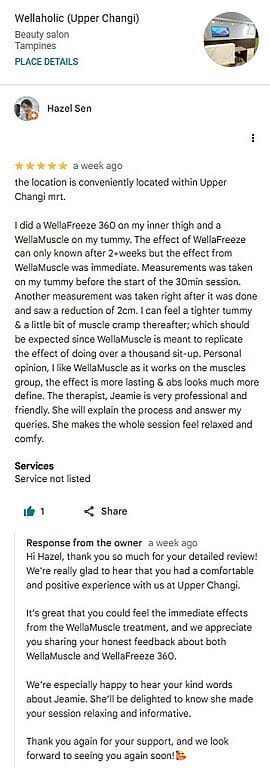
Hazel, a Wellaholic customer at our Upper Changi outlet, shares her experience with WellaMuscle™. Located within Upper Changi MRT, she found the outlet convenient for her appointment. During her visit, she tried WellaFreeze 360 on her inner thigh and WellaMuscle™ on her abdomen. While results from WellaFreeze take time, she noted her experience with WellaMuscle™ was immediate — measurements taken before and after the 30-minute session showed a 2cm difference, and she felt her abdomen was tighter with mild muscle sensation afterwards. Hazel shares that she prefers WellaMuscle™ as it works on the muscle groups, and found the definition more noticeable to her. The service at Upper Changi stood out for being professional and friendly. Our senior therapist explained the process, addressed her queries, and helped the session feel relaxed and comfortable. Hazel notes the overall experience at Wellaholic as one she would consider again.
Read Actual Review by Customer
“the location is conveniently located within Upper Changi mrt.
I did a WellaFreeze 360 on my inner thigh and a WellaMuscle on my tummy. The effect of WellaFreeze can only known after 2+weeks but the effect from WellaMuscle was immediate. Measurements was taken on my tummy before the start of the 30min session. Another measurement was taken right after it was done and saw a reduction of 2cm. I can feel a tighter tummy & a little bit of muscle cramp thereafter; which should be expected since WellaMuscle is meant to replicate the effect of doing over a thousand sit-up. Personal opinion, I like WellaMuscle as it works on the muscles group, the effect is more lasting & abs looks much more define. The therapist, Jeamie is very professional and friendly. She will explain the process and answer my queries. She makes the whole session feel relaxed and comfy.” (Source: Google Review)

Conclusion
DOMS is the price of training hard enough to adapt, and managing it well is what allows training frequency and quality to compound over time. Surface recovery tools — rest, foam rolling, massage — are valuable and should remain part of any recovery routine. What deep electromagnetic stimulation adds is access to the fibre-level layer where the repair process is actually happening, supporting circulation and recovery at the depth that surface tools cannot reliably reach.
WellaSoothe sessions are available at all four Wellaholic outlets, positioned across Singapore to fit into a training week without significant additional travel. The Tanjong Pagar outlet serves CBD gym-goers who train near the city centre. The Kovan outlet is open until 10pm for those who train after work in the north-east. The Upper Changi outlet sits inside the MRT station for commuters on the East-West line. The Somerset flagship is three minutes from Somerset MRT in the Orchard area. Wellaholic’s expert team is available at each location for a no-pressure conversation about where WellaSoothe fits in your current recovery stack.
Key Takeaways
- DOMS originates at the sarcomere level: Microscopic tears in the muscle fibre’s contractile units during eccentric loading trigger an inflammatory repair cascade — not lactic acid accumulation, which clears within an hour of training.
- Passive rest supports but does not accelerate repair: Complete rest allows the inflammatory process to proceed at its natural pace but does not actively drive the circulation and substrate delivery that the damaged tissue needs.
- Surface tools address the accessible layers: Foam rolling and massage effectively manage myofascial tension and intermediate muscle soreness but cannot reliably reach the deep fibre layer where heavy compound training concentrates DOMS.
- Deep electromagnetic stimulation reaches the repair site: High-intensity electromagnetic energy induces contractions in deep muscle fibres, driving a pump effect that improves local circulation and supports clearance of inflammatory mediators at the tissue level where repair is underway.
- Singapore’s training frequency and climate compound recovery demand: High training frequency, compressed recovery windows, and ambient heat create a recovery environment where surface tools alone often cannot keep pace with the volume being trained.
Frequently Asked Questions (FAQ)
Q1: What is DOMS and why does it happen after training?
DOMS stands for delayed onset muscle soreness — the localised muscle pain and stiffness that develops 12 to 48 hours after exercise, particularly after training that involves significant eccentric loading. It results from microscopic tears in the sarcomeres during the lengthening-under-load phase of movements, triggering a localised inflammatory repair response. The soreness comes from this inflammatory process sensitising nearby nerve endings, not from lactic acid, which is cleared from the muscle within an hour of training.
🔵 Eccentric loading origin: Movements like squats, deadlifts, and the lowering phase of resistance exercises generate the most DOMS-producing stress.
🔵 Sarcomere micro-tears: The contractile units of the muscle fibre sustain microscopic damage that triggers the repair and adaptation response.
🔵 Inflammatory cascade: Prostaglandins, cytokines, and localised fluid accumulation sensitise nerve endings, producing the characteristic aching and stiffness.
🔵 Not lactic acid: The lactic acid theory of DOMS has been disproven — lactate clears from muscle tissue within 60 minutes of exercise.
🔵 Adaptive purpose: DOMS reflects a productive training stimulus — the repair process leaves the fibre stronger than before.
🔵 Peak timing: Soreness typically peaks 24–48 hours post-training, which is why the worst discomfort arrives the morning after rather than immediately.
Q2: How long does muscle soreness typically last after exercise?
For most people training at moderate to high intensity, DOMS resolves within two to four days as the inflammatory repair process completes and the affected tissue returns to baseline. The timeline varies by training intensity, the muscle groups involved, individual recovery capacity, and how well recovery is supported between sessions. Large lower-body muscle groups — quadriceps, hamstrings, glutes — typically take longer to resolve than smaller upper-body muscles due to their greater fibre volume and the mechanical demand placed on them during compound exercises.
🔵 Typical window: Most DOMS resolves within 48–96 hours for moderately trained individuals at standard training intensities.
🔵 Intensity dependency: Higher training volume and intensity produce more pronounced and longer-lasting soreness.
🔵 Muscle group variation: Large compound muscle groups like quadriceps and glutes typically require more recovery time than smaller isolation muscles.
🔵 Training history factor: Well-trained individuals with established adaptation to a movement pattern generally experience less severe DOMS than novices at the same relative intensity.
🔵 Recovery quality influence: Sleep, nutrition, hydration, and active recovery practices all influence how efficiently the repair process proceeds.
🔵 Singapore heat factor: Training in Singapore’s warm and humid environment accelerates muscle fatigue during sessions, which can intensify post-training soreness relative to training in cooler conditions.
Q3: Does massage actually help with post-workout recovery?
Sports massage has a solid evidence base for reducing the subjective perception of DOMS and improving short-term range of motion, primarily through its effects on myofascial tension and the autonomic nervous system’s recovery response. It increases local circulation in the treated area and reduces surface and intermediate muscle tightness effectively. The limitation is depth — the deep muscle fibres where DOMS is most concentrated after heavy compound training lie below what manual pressure can reliably reach.
🔵 Subjective soreness reduction: Multiple studies support massage reducing perceived DOMS ratings at 24 and 48 hours post-training.
🔵 Myofascial effect: Compression and friction techniques release surface adhesions and reduce neural sensitivity in the superficial tissue layers.
🔵 Circulation benefit: Massage improves local blood flow in treated areas, supporting clearance of inflammatory mediators from the surface and intermediate layers.
🔵 Parasympathetic activation: The relaxation response triggered by massage supports systemic recovery beyond the local tissue effect.
🔵 Depth limitation: Deep muscle fibres in large compound muscle groups are not reliably reached by manual pressure alone.
🔵 Complementary role: Massage remains valuable as part of a recovery stack — the gap is in reaching the fibre-level layer beneath its accessible range.
Q4: What does EMS muscle stimulation do during recovery?
Electromagnetic muscle stimulation induces involuntary contractions in deep muscle fibres by delivering high-intensity electromagnetic energy through the skin and surface tissue layers to stimulate motor neurons directly. During DOMS recovery, this produces a pump effect in the deep tissue — the rapid alternation between contraction and release drives local circulation, delivering repair substrates to the damaged fibres and clearing inflammatory mediators more efficiently than passive rest achieves. The mechanism operates at the depth where heavy compound training concentrates fibre-level damage.
🔵 Motor neuron stimulation: Electromagnetic energy directly activates the motor neurons supplying deep muscle fibres, bypassing surface layers.
🔵 Depth of access: Contractions are induced in deep muscle groups that foam rolling and manual massage cannot reliably reach.
🔵 Pump mechanism: Rapid contraction-release cycles drive circulation in the deep tissue, supporting the delivery and clearance functions the inflammatory repair process depends on.
🔵 Substrate delivery: Improved deep circulation brings oxygen, glucose, and amino acids to the repair site more efficiently than passive rest.
🔵 Mediator clearance: The pump effect accelerates the removal of inflammatory by-products from the deep tissue, supporting the return to baseline.
🔵 No physical effort required: The electromagnetic stimulation produces the contractions independently — no exertion is required from the customer during the session.
Q5: How is WellaSoothe different from a sports massage?
Sports massage and WellaSoothe address different tissue layers and work through different mechanisms — they are more complementary than competitive. Sports massage works through manual pressure on the surface and intermediate layers, reducing myofascial tension and activating the autonomic recovery response. WellaSoothe uses electromagnetic stimulation to induce contractions in the deep muscle fibres below the reach of manual pressure, supporting circulation and recovery at the level where heavy training concentrates DOMS.
🔵 Tissue layer distinction: Sports massage addresses superficial and intermediate layers; WellaSoothe targets the deep fibre level.
🔵 Mechanism difference: Manual pressure versus electromagnetic neuromuscular stimulation — different tools producing different physiological effects.
🔵 Passive receipt: WellaSoothe sessions require no physical effort — the stimulation does the work while the customer rests.
🔵 Time format: A WellaSoothe session can be completed in a lunch break or post-work slot without the preparation or exertion a physical massage session involves.
🔵 Stacking logic: Many customers use both — sports massage for surface and intermediate tension, WellaSoothe for the deep layer — within the same recovery week.
🔵 No manipulation: WellaSoothe involves no physical pressure, joint manipulation, or physical contact beyond the electromagnetic applicator.
Q6: Where can I book a WellaSoothe session in Singapore?
WellaSoothe is available at all four Wellaholic outlets across Singapore, each accessible without significant additional travel for gym-goers across different parts of the island. Wellaholic’s expert team conducts an initial assessment at the first visit to understand the customer’s training pattern and identify the muscle groups most in need of recovery support. No prior experience with electromagnetic muscle stimulation is required — the first session includes a full explanation of the process.
🔵 Somerset: Flagship outlet three minutes from Somerset MRT Exit B, convenient for gym-goers training in the Orchard and Dhoby Ghaut area.
🔵 Tanjong Pagar: CBD outlet at 210A Telok Ayer Street, accessible from Tanjong Pagar and Raffles Place MRT for post-gym sessions in the city.
🔵 Kovan: Heartland outlet open until 10pm — suitable for north-east residents who train after work and want recovery support the same evening.
🔵 Upper Changi: Located inside Upper Changi MRT station at platform level, convenient for East-West line commuters heading home after training.
🔵 No commitment required: The first visit is a consultation and assessment — customers are not required to commit to a programme before trying a session.
🔵 Flexible booking: Sessions can be booked online or arranged directly at the outlet without a referral or prior appointment at most locations.
About Wellaholic’s Expert Team
Wellaholic’s treatments are designed and overseen by our founding team, whose qualifications include a CIDESCO Diploma in Aesthetics and a Level 3 Certification in Beauty Therapy & Salon Management from Brentwood College UK. With hands-on experience across IPL, SHR hair removal, and a wide range of aesthetic treatments, our founders bring both academic grounding and practical expertise to every service protocol at Wellaholic.
Our Aesthetic Director holds a CIDESCO certificate in skin care and a Bachelor of Health Science (Aesthetics) from Torrens University of Australia, with over a decade of industry experience spanning Singapore and Australia. Her background includes a senior role at a leading laser aesthetics group, giving her deep insight into safe and effective treatment delivery across diverse skin types.
Together, Wellaholic’s expert team has served over 18,000 customers across four outlets in Singapore — Somerset, Tanjong Pagar, Kovan, and Upper Changi — and has been recognised at the Beauty Insider and Daily Vanity Awards.
Contact us at support.
GET IN TOUCH
Book Now Pay Later

WellaMuscle™ – Build Muscle, Melt Fat & Tone Your Body
- ⭐ HI-EMT Technology. WellaMuscle™ uses High-Intensity Electromagnetic Technolog (HI-EMT) to stimulate muscle contractions and burn fat cells in targeted areas of the body.
- ⭐ 16.3% Increase in Muscle Mass. According to clinical studies, treatments like WellaMuscle™ can help you gain up to 16.3% more muscle mass in the treated areas after four sessions.
- ⭐ Effective on Abs, Buttocks, Arms, Thighs and Calves. WellaMuscle™ is effective on the large muscle groups of the abdomen and buttocks, as well as the smaller muscle groups of the arms, thighs, and calves.
- ⭐ Award-Winning. Wellaholic’s treatments have been recognized by top beauty publications such as Daily Vanity, Beauty Insider, and Tropika Club Magazine.
- ⭐ Over 2000 Verified Customer Reviews. Wellaholic has over 2000 positive reviews from customers, and >50% are repeat customers.